“Taji Tower, We Have an Aircraft Down”
“Taji Tower, We Have an Aircraft Down”
by Captain Bob Asher, Ret.
The UHF radio was jammed with traffic. I thought of calling out a Mayday over Taji tower’s frequency, but it probably would have caused more confusion. Rather than talk over the other aircrafts’ transmissions, I waited for a few seconds. It seemed like an eternity, but finally there was an opening, and I transmitted, “Taji tower, Horserider 63.” The bored, but efficient Taji controller responded, “Horserider 63, go ahead.” “Taji, Horserider 63, we have an aircraft down. Prepare to copy coordinates,” I said as I punched target store on our GPS. That got everyone’s attention. At that moment, we became the number one priority in Iraq. The controller announced, “All aircraft hold traffic. Horserider 63, go ahead with coordinates.”
Our company, Company C, 1-106th Aviation (Assault), was a UH-60 Blackhawk unit in the Missouri Army National Guard. We were mobilized on December 20th, 2003 at Jefferson City in support of Operation Iraqi Freedom II. Except for our Detachment 1 of Delta Company, the rest of the battalion was from Illinois. We met up with the battalion at Fort Knox for predeployment training and arrived in theater on February 29th, 2004. Our battalion was sent to Balad Airbase, about 60 miles north of Baghdad. As a Multi-National Corps-Iraq asset, our area of operation encompassed the entire country of Iraq. Our missions ran the gamut. We did pretty much everything, from transporting VIPs (Coalition Provisional Authority Officials, Interim Iraqi Government Leaders, and Flag Officers from all the coalition countries) to night-vision goggle insertions of Quick Reaction Forces conducting raids and ambushes. As the threat of improvised explosive devices (IEDs) on the roads continued to rise, so did our operational tempo. We fell into a routine of day missions that lifted off at sunrise and returned to Balad at sunset. The summer months brought with them another potentially lethal threat. The temperature climbed to over 100 degrees for three months straight, and on some days it would rise to as high as 130 degrees inside our helicopters. It was so hot in the cockpit that I could not hold my gloved hand on the top of my helmet. On several occasions, passengers were overcome and had to be helped off the aircraft. Autumn arrived, and the temperature dropped to a tolerable level, but the operational tempo never slowed.
We were fortunate compared to other units. We knew we were being shot at on our missions, but it could be just as dangerous while on the ground at Balad, because of the mortar and rocket attacks. Some wise guy started calling Balad Airbase, Mortaritaville, and the nickname stuck. We saw the reports of aircraft being shot down by anti-coalition forces or crashing in bad weather on occasion, but it never hit home with our company. They were like ghost stories. They were scary, but they weren’t real. The battalion had made it through eight months of the deployment without a combat casualty. We had established sound tactics, techniques, and procedures (TTPs) that we adhered to. The flight companies each had their own unit identities, but we got along and fought well together.
November 12th started out as another Groundhog Day in Iraq. Wake up at 0400 after a night of not enough sleep, mission brief at 0500, and takeoff at sunrise (around 0630). Today’s mission was a flight of two Blackhawks. The lead aircraft was Horserider 56, flown by pilot in command, CW4 DM, and pilot, CPT Tammy Duckworth, and crewed by SGT CF and SPC KH. CPT Duckworth and SPC KH were both from the Illinois Guard and were assigned to the battalion’s Tactical Operations Center (TOC). They both liked to get out of the TOC and fly missions whenever possible. Chalk two, Horserider 63 was flown by pilot in command and air mission commander, CW3 PM, and his copilot, me. Our crew was SGT JF and SPC MB. The mission was in support of the 1st Cavalry Division. We were to fly 1st Cav soldiers and contractors to and from the numerous camps and forward operating bases (FOBs) in and around Baghdad during the morning and again that afternoon. Then, after we dropped off the last soldier, we would race the Sun back to Balad. As I said, it was another Groundhog Day. We had done similar missions almost daily for months. This time, somewhere along the way, we picked up a space available passenger, COL H. He was assigned to the 13th COSCOM and had only been in country about a week. The Colonel was trying to get to Balad, so he could catch another hop to his FOB in Northwestern Iraq. COL H was the only passenger on Horserider 63 at the end of the day as we streaked for home.
Horserider 56 was leading us back to Balad as we passed Taji on our left. Per our TTP, we never flew a straight line for more than a few seconds. We were constantly varying our heading and altitude. CW4 DM was flying his aircraft from the left seat, and CPT Duckworth was handling the radios and navigating from the right. The Air Mission Commander, CW3 PM, had let me stick hog most of the day, so he took the controls on the flight back to Balad. At this point, I had the easiest job in the flight: backing up CPT Duckworth with the radios and navigation. Since CW3 PM was flying from the left seat, he positioned our aircraft on the right side of the lead about 500 feet from them at their 4 to 5 O’clock. We were maneuvering across the terrain about 50 to 75 feet above the ground at about 120 Knots. The route we were flying near the Tigris River was covered with date palm groves. The flight crossed over the Tigris and flew over another palm grove about 15 to 20 feet above the trees. I was alternating between checking my map and scanning my sector outside as we approached a clearing in the grove. I had my head down checking my map when I heard CW3 PM say over the intercom, words to the effect, “What was that?” He began decelerating the aircraft immediately, and SPC MB responded that he saw puffs of smoke come up from the tree line.
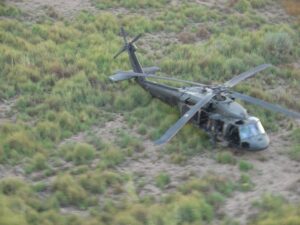
Two rocket-propelled grenades (RPGs) and AK-47 rounds had struck Horserider 56. CPT Duckworth took the brunt of the RPG explosions and was incapacitated. Her right leg was severed above the knee, where her armored seat ended. Her left boot sat limply on the floor. The armor panel that was supposed to protect her upper right side was blown off its tracks and broke her right arm. She remembered being conscious and trying to help fly the aircraft. She passed out as the aircraft touched down. CW4 DM felt the impact, and a flash came through the cockpit, singeing his eyebrows and the hair on his neck. The explosion disabled his radios and instruments. He immediately began decelerating for landing. He could feel his controls stiffen as he approached the ground. He landed within a kilometer of the ambush site. If he had tried to continue further and the controls seized up in flight, the results would have been disastrous. SGT CF was also wounded. The impact of the explosion had driven the armor panel under his right side gunner’s window into his right leg, shattering it below the knee. He looked to the cockpit and saw CW4 DM flying the aircraft. The insulated overhead sound-suppressing panel was on fire, and hydraulic fluid from the flight control system was leaking through it. SGT CF smeared the hydraulic fluid over the fire with his gloved hand in an attempt to put it out. SPC KH, in the left gunner’s seat, had been stunned by a sharp pain that radiated up through his body as if he had been kicked in the rear. He felt under himself to check for injury and discovered blood on his glove. An AK-47 round had come up through the floor of the aircraft and struck him. It lodged against his pelvis. Fortunately, the only crewmember on 56 not wounded was the Pilot in Command flying the aircraft.
From my right seat, I couldn’t see what was going on until we decelerated enough for Horserider 56 to pass us. I couldn’t see anything wrong with the aircraft at first as 56 continued to slow down and descend into the clearing. CW4 DM made what looked like a normal no-hover landing in the clearing, but he never called to say he had a problem. I tried to call them but got no response. We slowed and flew in front of 56. I could see that the cockpit glass (greenhouse) above the right seat was blown out, and the rotor blades were spinning down. CW3 PM continued our turn to the left to orbit 56, and I called Taji tower to report the downed aircraft. CW3 PM landed our aircraft to the right front, facing 56 about 100 feet away. CW4 DM was already outside his aircraft and waving frantically for us to come and help him. SGT JF and SPC MB jumped out and ran to help him. I attempted to alert our battalion TOC on our HF radio because I was certain they wouldn’t hear me on the UHF radio, but the radio wouldn’t link up. While I was getting frustrated with the radio, COL H jumped out and ran to help the others. He didn’t have an intercom hookup, so he couldn’t hear what was going on. COL H and SPC MB removed CPT Duckworth from her seat and, with quite a bit of difficulty, began carrying her back to our aircraft. Her body was very bloody, and they had a hard time holding on to her. SPC KH was able to walk back to our aircraft on his own, but the backside of his flight suit was bloody. SGT JF was trying to carry SGT CF back, but couldn’t do it alone. I told CW3 PM I was going to go help him and hopped out of the cockpit. I also realized why everyone was having such a hard time moving around. The ground had been cultivated in the past, and the area had overgrown with clumps of tall grass and weeds varying from three to six feet high. The grass was so high we had no way of knowing if the enemy was closing in on us. The enemy was within 1,000 meters, and a dirt road ran along the edge of the clearing. Even on foot, they could have traveled to us in a few minutes. I saw a Blackhawk fly overhead, and I breathed a sigh of relief. Two aircraft from our battalion had been in the area and heard my call. While they orbited, they came under attack and were hit by small arms, but remained overhead. When I reached SGT CF, I couldn’t tell where he was wounded. I yelled over the engine noise to SGT JF that I would help carry SGT CF. We all had our flight helmets, armor, and survival vests on. The helmets made hearing each other difficult. We picked up SGT CF, and he began screaming from intense pain. He said his right leg was broken, and the pain was too much for us to lift him. I told SGT JF that we had to go, and we would drag SGT CF back to our aircraft. We grabbed him by his survival vest and started moving. It was less than 100 feet, but we fell several times. CW4 DM covered us with an M-4. When we got back to the aircraft, the others already had CPT Duckworth lying on the floor between the seats. I could see her face under her helmet visor. Her eyes were closed, and her skin was ashen gray. She didn’t move. I was a police officer for 12 years, and I’ve seen a lot. I feared she was gone. We lifted SGT CF inside, and after I was certain everyone was accounted for, I climbed back into the cockpit. While I was on the ground, CW3 PM had been busy coordinating with our cover aircraft and arranged to have Medivac meet us at Taji. He took off and flew as fast as our engines would allow. We were cleared direct to Lobo pad at Taji, and as we set down, the Medivac bird landed right next to us. We transferred our wounded to them, and they left immediately for the Combat Army Surgical Hospital (CASH) in the Baghdad Green Zone. From the moment of the attack to their arrival at the CASH, less than 30 minutes had elapsed. We taxied to the ramp and shut down to be debriefed. The 1st Cavalry mounted up a mechanized infantry company to sweep the area of the shootdown and secure the aircraft, but stopped short. They determined the area was so hot it wasn’t worth the risk. They called in attack aircraft and destroyed Horserider 56 with rockets and a Hellfire missile to deny it to the enemy.
As his Platoon Leader, I am especially proud of CW4 DM. He displayed remarkable airmanship and judgment in safely landing his aircraft after it had been severely damaged. All three of his crewmembers were wounded, and his flight controls were damaged. Once on the ground, he completed the emergency engine shutdown and then took charge of the scene. He ordered SPC KH to man the left perimeter with his M-4 and then went to the right side of his aircraft to check on CPT Duckworth. After finding her incapacitated, he went to check on SGT CF. He found SGT CF unable to walk as a result of his broken leg. CW4 DM pulled SGT CF from the aircraft and placed him on the ground with his M-4 and ordered him to defend the right side of the aircraft. I could not have asked for a better crew. Everyone performed well above my expectations.
Later that night, after returning to Balad Airbase, we learned all three of them had survived. SPC KH was released from the hospital and flew back to Balad with our battalion commander, LTC FA, and our company commander, CPT EB. He had an X-ray of the bullet in his rump with him that he proudly displayed. He was told he should get a wallet-sized copy made to show the TSA people when he sets off their metal detectors. SGT CF was evacuated back to Germany and then the United States. The doctors were able to regrow the bone he lost, and after a lengthy recovery, he was able to return to flying status. CPT Duckworth was the most grievously wounded and required a longer recovery. She lost both of her legs and broke her right arm. She was promoted to Major while in the hospital and later went on to serve as an Assistant Secretary of Veterans’ Affairs and as a Congresswoman in the House of Representatives. Now she serves as a Senator from the State of Illinois.
This was the only shootdown our battalion incurred during our deployment. It was well known that RPGs are a serious threat when a helicopter is landing or taking off, but never in my wildest dreams would I have believed that you could hit a helicopter with an RPG, much less two, as it zoomed by overhead. Despite how well a mission is planned and conducted, you can’t always control or anticipate what the enemy will do. As General Tommy Franks said in his book, “The enemy gets a vote.”

Hi Bob, I’ve commented on Facebook as well, but just wanted to share my thoughts on here. Truly remarkable story, one of many no doubt that get lost over history as people play down their parts and put it down to just ‘doing my job’. Glad to hear everyone made it back alive at least. Thanks for taking the time to share this. I loved the honesty of your account, keeping it real, the mention of falling over when conducting casevac is poignant as it hammers home the realities of real life versus hollywood. Thanks for taking the time to put this out there.
ML, thank you for your comment. I’m very proud that everyone did their part that day to bring everyone out alive.
Bob, as one of your fans I read all of your books. This account of what happened kept me on the edge of my seat. So glad everyone made it out alive.
I work as a DOD contractor and paramedic for Iraqi freedom. I started in the south at Camp Bucca next to the Tigris any Euphrates. I was on convoy and stopped at The Air Base Talil in the city of UR. I work there for a while and then was sent to Joint Base Balad. It was sometime in 2010 when a helicopter crashed on our base. Some of the soldiers didn’t make it. What really touched my heart, One of The walking wounded carried the flag under his arm. I took the worst wounded to the Trauma Center. Is true what you said about mortarville. Fortunately for us the base was heavily fortified with Cram systems. Thank you for the service and sacrifices you made for our country and I will keep reading all of your books.
Jeff, thank you for your comment. We were deployed to Balad from February 2004 to February 2005. I think the C-RAM was operational at Balad in the summer of 2004. I remember we would check in with Balad Tower and tell them what sector we were coming in from. It never fired while I was coming in or leaving, but if they called out that the C-RAM was about to fire, we planned to land immediately, no matter what direction they were firing.
Bob,
I have hears the story many times and have the pleasure of knowing and deploying with PM, CF, and DM in the Cco 2009-2010 deployment to Iraq. You could not have stated better how well the crew and personnel performed. I have flown with many other airmen, but the soldiers of Cco 1/106 were second to none. I had the displeasure of going down with Acft 401 in Iraq on that deployment and once again the professionalism and skills of Cco’s aviators were on full display. I am thankful for your service and your writings. I still have a copy of Bullseye Bob. God bless.
Aaron,
Thank you for your comments and your service. DM and I had a lot in common. We were both police officers in West St. Louis County and we shared a room with two other aviators at Fort Knox during our pre-mob training. I was the platoon leader for DM and CF. After the dust settled from the shoot down we kidded DM that if he lost two more aircraft he would be an enemy ace. As far as PM goes, I think he is one of the finest men I’ve ever known. He set an example before, during, and after the deployment that was imposssible to match. Thanks, again and best wishes,
Bob