“2205, Shots Fired!”
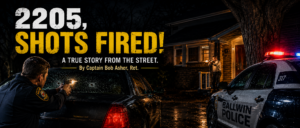
“2205, Shots Fired!”
by Captain Bob Asher, Ret.
“2205, domestic disturbance in progress at 2211 Pleasant Grove Avenue. Caller reports her father is downstairs, attacking her brother,” the Ballwin, Missouri police dispatcher transmitted over the police radio.
“Radio, 2205, 10-76,” I replied from my cruiser, marked unit #317, a white Ford Crown Victoria. 10-76 was the police ten code for en route. It was about 0230 hours on a freezing Saturday night in February, and I was patrolling my assigned area on the north side of Manchester Road, Sector 2. I had been a police officer for about 14 months. After leaving active duty in the Marine Corps and graduating from the police academy, I had completed the field training program and was patrolling on my own.
“2173, en route to assist,” Dave W, the officer assigned to Sector 3, transmitted. He was patrolling the neighboring city of Clark Valley, so it would take him a few minutes to arrive.
I was on Manchester Road, maybe a mile away, so with no traffic and my emergency light flashing, I turned onto Pleasant Grove in less than two minutes. The house was in one of our older subdivisions, so there were lots of mature trees blocking the light coming from the streetlamps. I thought I knew about where the house was, and I didn’t want the suspect to know I was arriving, so I turned off my headlights and lightbar and slowly crept down the street. The house was on the left side, and I couldn’t see the address on the mailbox until I drove past it. I parked on the left side of the street beyond the driveway and a line of tall shrubs bordering the front yard. “2205, 10-21,” I transmitted before I exited the car, being careful to gently close the door. I’m left-handed, so I had my trusty five-cell aircraft-grade aluminum Maglite in my right hand to keep my gun hand free. As I walked up the driveway, there was enough light from the nearest streetlamp that I didn’t need my Maglite on, so I kept it down at my side. I knew better than to enter the house alone. I intended to get up close to the house and listen for any fighting going on inside. If anyone was screaming for their life, I would go in without backup. As I approached a green Lincoln Town Car parked on the driveway, a balding middle-aged white male stepped out of the side door of the house in front of the Town Car. He was wearing a white long-sleeved shirt and dark trousers. He didn’t seem agitated. He looked like any other suburban homeowner. I was about to go into my “Good morning, sir. Is there a problem?” spiel when he closed the door, turned toward me, raised his arm, and I saw a brilliant flash of light followed immediately by the sound of a cannon being fired.
A lot went through my head at that moment, thankful not a bullet. I dove to my right behind the trunk of the Town Car, scraping my left palm, the knuckles of my right hand, and my knees. Without thinking, I dropped the Maglite and came up on my knees behind the car. My .40 S&W Glock model 22 was already in my left hand. I leveled it across the trunk lid. The suspect, a 49-year-old insurance salesman, had already descended the three steps to the driveway and was at the left front of his Town Car. I immediately began firing through the rear and front windows. As the glass started exploding, he ducked down. I fired eight rounds into and through the Town Car at him as he moved to the front right side of the car. I got to my feet and fired two more rounds into the driver’s door and window as I ran about twenty feet to a large oak tree in the middle of the yard. It provided much better cover than the auto glass and thin sheet metal on the car’s body.
I retrieved my Motorola walkie from my right hip. We didn’t have shoulder mics back in the 1990s. “2205, shots fired!” I quickly said into the radio. I don’t think I was shouting, but I communicated the urgency of the situation. You would think that after being shot at and then popping off ten rounds of my own on an otherwise peaceful night, my ears would be ringing worse than hunchback of Notre Dame’s, but they weren’t. I could hear everything. I could hear the insurance salesman complaining from the far side of the Town Car that I had shot at him. I could hear the wind blowing.
And then the response came over the radio very slowly. “What did he say? I think he said shots fired,” the nice elderly lady back at the station transmitted.
Instantly, Dave keyed his car’s radio mic. I could hear his siren blaring as he transmitted, “He said, shots fired. I’m 10-21!”
I yelled at the suspect, “Put the gun down! Come out on the driveway and get on your face!” And then instead of complying, he shouted something incoherent. I heard Dave pull to a stop about thirty feet behind me. Then I heard his door slam and a round being jacked into his Remington 870 shotgun. I didn’t have to look, I knew it was him.
He came up behind me and asked, “Where’s the shooter?” I told him, and we both began yelling at him to surrender.
Finally, the idiot put his hands up, came out from behind the car, and lay face down on the driveway. We approached cautiously with our guns pointed at him. I leaned over him with my Glock pointed between his shoulder blades and shouted, “Where’s the fucking gun! Where’s the fucking gun!” I hadn’t been that amped up since Horserider 56 was shot down in Iraq. Let me take a minute to talk about stress. Do you know what the real definition of stress is? It’s wanting to stomp that guy’s head in for trying to kill me, but knowing I couldn’t because if I did, I would lose my job and go to jail. Back to the story. I wouldn’t holster my Glock until I knew he was unarmed. He motioned with his head toward the porch next to the front of the Town Car. Dave was covering him with the shotgun, but he saw I wasn’t holstering my Glock. He got tired of waiting for me, so he put the shotgun behind him and handcuffed the knucklehead himself. Dave quickly searched him and hurried to the porch to look for the gun. People started coming out of the house, and I would have had a lot of explaining to do if I didn’t find the gun. There it was, sitting on the wooden porch next to the Town Car, a shiny nickel-plated revolver. It turns out that when I started shooting back, it startled him so bad that he dropped his gun.
Then more police, an ambulance, and a fire truck arrived. The ambulance was for the salesman’s college-aged son. Dad came home intoxicated and found his son lying on the living room couch making out with his girlfriend. He kicked his son in the face, which “kicked off the fight.” The son got up to defend himself, and once Dad started losing, he disengaged and hurried to his desk. The son knew that was where Dad kept his pistol, so he ran from the house, leaving his girlfriend to fend for herself. Meanwhile, the salesman’s college-aged daughter was upstairs in her bedroom making out with her boyfriend. She heard Dad attack her brother, and she called the police.
Being a suburban police department of about fifty officers, the watch commander decided not to call out any detectives to investigate and process the scene for evidence. They were all home in bed, and overtime would have been involved. After all, there was a lot of noise, but nobody got killed, right? It was decided that I would assist Dave in processing the scene of my own shoot-out while another patrol officer investigated, then wrote the report, and applied for the felony arrest warrant the next morning.
After a “lengthy” investigation, the facts were revealed. The salesman and his wife had been in downtown St. Louis celebrating their anniversary. They checked into the Ritz Carlton Hotel, and after a fine dinner, they traveled across the river to enjoy the gambling boat. Dad lost some money and drank so much that it ruined the evening for his wife. She kicked him out of the hotel room, and he decided to drive home to Ballwin, some twenty miles away, while intoxicated. He arrived home to find everyone else enjoying themselves but him. The son ran from the house to hide in the backyard. I arrived seconds later, just in time for the salesman to come outside and try to kill me. To be fair, he later said he thought I was his son. A Metro-West Fire District fireman lived across the street. He and his wife were sleeping when gunfire erupted. He rolled out of bed and shuffled to the window to see what was happening. He told his wife, “It’s okay. It’s just the police,” and shuffled back to bed.
After processing the scene, Dave and I returned to the police station just in time for shift change at 0530. One of our firearms instructors from the other squad, another Dave, asked, “How many rounds did you fire?”
I said, “Ten.”
“Here you go,” he replied as he counted off ten rounds into my palm.
It wasn’t like on TV, where the shooting team from Internal Affairs comes out and takes your gun and goes over every detail with you for hours. The next night, I reported for shift change and hit the street at 2200 hours as scheduled. I patrolled Sector three all night without incident. Then, on Monday morning, the Captain called and woke me. “Hey, Bob. The chief said to take the next three days off.”
“How come?” I asked. Am I suspended? I wondered.
“The policy says you should have three days off with pay while the investigation is being conducted,” he explained.
“But I worked last night,” I replied.
“Yeah. I guess nobody thought of it at the time,” he said.
Days later, I went to the Preliminary hearing. A preliminary hearing is where a judge determines whether enough evidence exists to send a felony case to trial. If probable cause is established, the case is “bound over” for trial. I appeared in uniform. I was sworn in, and the prosecutor asked me to explain what occurred, and I did so.
Next, the defense attorney got his turn. He had a yellow legal pad full of questions. He didn’t have a defense for his client’s actions, so he tried to discredit me. He started going through his list of gotcha questions, asking about my pistol, what kind of ammo I carried, and so on.
The judge stopped him cold. He turned to me and asked, “Officer, were you carrying your duty weapon that night?”
“Yes, sir,” I replied.
“Is that it in your holster?” he asked as he pointed.
“Yes, sir,” I replied.
“Was it loaded with your duty ammunition?” he asked.
“Yes, sir,” I replied.
The judge nodded and turned back to the defense attorney and said, “Okay, move on to something else.”
And that’s the way it went. Whenever the defense attorney tried to get slick, the judge would shut him down.
Bond was set at $200,000 for Assault First Degree on a Law Enforcement Officer and Armed Criminal Action (ACA). So that’s ten to 30 years or life in prison for the assault charge and a three-year minimum for ACA. The salesman had to sit in jail awaiting bond until his wife cooled down enough to agree to put their house up for collateral. Ultimately, the prosecutor and defense agreed to a plea deal where the salesman would plead guilty to a lesser charge and be sentenced to five years’ Suspended Imposition of Sentence. What a deal, right? Promise not to try to assault another cop for five years and just go on with your life.
Oh! One more thing. A few weeks later, the salesman’s car insurance company called the police station and asked the clerk for a copy of the drive-by shooting report. She asked him to repeat that. He said, “My policyholder’s Town Car was shot up in a drive-by shooting in his driveway. I need a copy of the report so I can process his claim.” She put him on hold to transfer him to the captain. He repeated his request to the captain. The captain said, “Well, it wasn’t a drive-by shooting. It was us, and we stopped.” The agent was quiet for a moment and said, “I guess we won’t be paying this claim.” So, after dodging decades in prison, this scumbag had the gall to commit insurance fraud in hopes of getting his car fixed.
Everyone knows how empathetic cops are. About as much as a school of piranhas. A fake advertisement featuring a bullet-riddled Lincoln Town Car was pinned to the bulletin board in the Squad Room. The caption said, “If you want your vehicle customized, call Bob.” That’s as close to a sympathy card as you will get with cops.

Good story
Thank you, Tom.
Looks like a great read!
Thank you, Bill.
Well told recreation of your famous Scotland House shooting Bob! I remember the Town Car ad with the bullet holes well. I may have added a few. 😆
Hope you and the family are doing well.
Thank you, Jim. Yes, my family are doing fine. I hope yours are well also. The Town Car ad reminds me of a story I read about British SAS trooper Andy McNab, author of Bravo Two Zero. He evaded capture all the way across Iraq only to be captured at the Syrian border. When he returned to England from being a POW in Iraq he was given a “welcome back” card from his unit. Inside a drawing depicted a deshelved and malnourished prisoner (McNab) chained to a midevil dungeon wall with his feet dangling off the ground. A dungeon guard stood in the doorway with his trouser down mooning McNab. That was all the sympathy he would receive.
Ruthless! I love it!
We’re all good. My youngest son joined the AF last year. Is making his way through the PJ pipeline. Jump school at Bennington for the next 3 wks. I’m not sure where he got his love of adrenaline from. Sure wasn’t me.
Are any of your books audio yet? That’s mostly what keeps me awake while I’m working.
Bob, that was a quite an experience. I’m surprised the salesman wasn’t incarcerated after shooting at you.
That was a great account of what happened and I enjoyed reading it keep up the good work.
Jeff, Thank you for reading the story. It was amazing sometimes how difficult it was to get the county prosecutor’s office to actual put somebody in prision. They were always early to plea charges down to a less offense so they could get a quick conviction rather than going ot trial. That way they could brag about their 97% convict rate when it came time for reelection.