A Lesson in Aircrew Coordination (or How to Start a Fight in a Helicopter in Five Easy Steps)
 Readers sometimes ask where I get the ideas for the military scenes in my Jon Smith novels. Some come from research, some from my imagination, and a few come from things I actually witnessed during my years flying helicopters in the Marine Corps and Army Guard. Here’s one of the stranger incidents I remember from my flight training days.
So, how do you start a fight in a helicopter cockpit in five easy steps? As a newly winged aviator, I was transferred to MCAS Tustin, California, to fly the CH-53D Sea Stallion with Marine Heavy Helicopter Squadron 361. Before reporting to the Flying Tigers, I had to learn to fly the Sea Stallion at the training squadron next door, HMT-302. I was about halfway through the five-month-long course when I shared a training flight with a captain who was an experienced helicopter aircraft commander. He had completed his three-year fleet tour and was learning to be an instructor at HMT-302. Two students were typically scheduled to go out with an instructor for four or five hours and split the flight time. While one student flew, the other would sit in the fold-down jump seat between and a little behind the pilots in the cockpit to observe and hopefully learn from them. Since the other student outranked me, he flew first, and I watched them in the cockpit. Our instructor was a captain whom I had flown with many times. He was a good instructor, but he looked kind of like Barney Rubble from The Flintstones cartoon. I had never met the student instructor. He had that model Marine look, as if he belonged on a recruiting poster. Let’s call him Captain Rock.
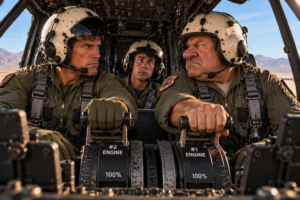
So it’s a beautiful day in SoCal except for the smog layer up to 5,000 feet as we take off out of Tustin and fly east toward the Saddleback Mountains to practice pinnacle and confined-area landings. Captain Barney is in the left seat, letting his student instructor have the aircraft commander’s seat on the right. Just as we reach our training area, Barney reaches up and pulls the #2 engine speed control lever back to idle, significantly reducing the helicopter’s performance on a hot day while we were full of fuel, and turns his head to watch what Rock does. Now, simulating engine failures is a normal part of helicopter training, but there’s usually one minor formality involved: telling the other pilot what the hell you’re doing.
Rock gives Barney a look that I translated as, “Are you stupid?” and then pushes the #2 Engine Speed Control Lever forward to 100%, where it belongs, restoring the helicopter to normal operation.
Barney frowns and gives Rock a “No! You’re stupid!” look and pulls the #2 Engine Speed Control Lever back to idle again.
Rock shakes his head in disgust, like he thinks Barney’s a moron, and pushes the lever back to 100% again.
Barney has had enough of Rock’s blatant disrespect for his authority and says, “You have a simulated #2 engine failure,” and pulls the lever back to idle for a third time.
Rock replies, “Well, you didn’t say that,” and then goes through the land as soon as practical emergency procedure steps for an engine failure.
That was the most pleasant part of the flight.
Barney began quizzing Rock on aircraft limitations, which, as an experienced aircraft commander, were seared into his brain over three years and a thousand hours flying the Sea Stallion.
Finally, Rock got tired of Barney treating him like a shavetail. He said, “Screw it. We’re going back,” effectively mutinying, and turned us 180° back to Tustin. There was no crew coordination on the way. Rock landed and taxied to the ramp. Instead of going through the shutdown checklist that I had been taught to follow, they both began flipping switches and pulling on levers so fast around the cockpit I couldn’t keep up. They unstrapped and almost bowled me over getting out of the cockpit. They stormed off, cussing at each other as they stripped off their helmets and survival equipment before disappearing around the corner of the hangar. I followed at a safe distance. As I peeked around the corner, I was surprised to see two Marine Corps aviators, the epitome of professionalism and control, rolling around in the dirt like a couple of five-year-old kids in a schoolyard. I looked around quickly and, not seeing any witnesses, backed away and returned to the helicopter to collect my gear. The last thing I wanted was to be called into a court-martial to testify against one or both of them
That was the only fistfight I witnessed during my six years in the Marine Corps. I learned two valuable lessons that day: effective aircrew coordination is essential to flight safety, and when two Marine captains decide to settle their differences with their fists, the wise lieutenant is one who didn’t see nothing.
